In collaboration with Curtin University, we developed a secure, offline AI system that automatically generates detailed, clinician-ready ECG reports. Powered by a local installation of Google’s Gemma 3.0 and a custom Retrieval-Augmented Generation (RAG) pipeline, the solution translates ECG classification outputs, clinical features, and patient data into structured, highly readable medical reports.
Problem
Curtin University needed a way to automate the time-consuming and manual task of writing ECG diagnostic summaries. The goal was to create a system that could quickly produce accurate, formatted reports based on model predictions and ECG feature data, while keeping all patient information private and offline. Prior to this, producing these reports required substantial clinician time and deep medical knowledge to interpret classification outputs correctly.
Solution
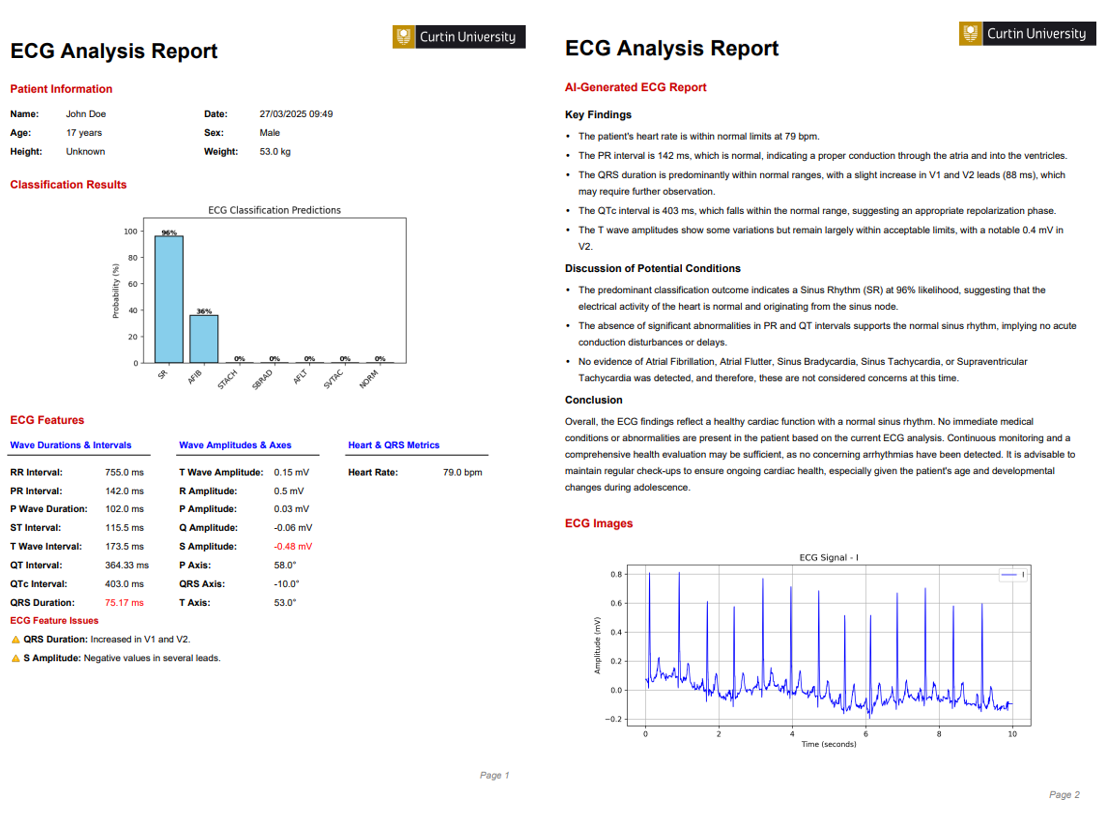
Figure 1: ECG report example output.
We delivered a complete AI-powered ECG reporting pipeline, hosted entirely on Curtin’s infrastructure for data security and compliance. The system ingests ECG classification outputs (across seven rhythm categories), detailed lead-by-lead clinical feature data, and patient demographics to generate PDF reports that are structured, stylised, and packed with insight. Each report includes:
- Narrative-style clinical interpretations with diagnosis confidence
- Highlighted feature abnormalities for quick triage
- Lead-specific time-series plots
- Patient demographic summaries and context
- Visual charts of classification probabilities
All analysis and writing is handled by a local AI agent, reducing report generation time from hours to minutes, while improving consistency and clarity.
Result
The system now enables researchers and clinicians to generate high-quality, personalised ECG reports instantly, saving hours of manual work and increasing confidence in ECG interpretation. It marks a step-change in how clinicians interact with ECG data: fast, reliable, and grounded in both patient specifics and best-practice literature. The reports are visually clean, medically accurate, and immediately useful, bridging the gap between machine output and clinical readability.


 Dr Andrew Maiorana, Curtin University